
History & Milestones
Founded in 1941 as ASPH, we expanded in 2013 to become the Association of Schools and Programs of Public Health (ASPPH), reflecting the full community of accredited schools and programs advancing population health.
This short video highlights the history and impact of ASPPH and the evolution of academic public health.
Our History
The history of ASPPH begins in 1941 with the founding of the Association of Schools of Public Health (ASPH), created by deans of accredited schools of public health and established to promote excellence in graduate public health education and strengthen the nation’s public health infrastructure. The founding deans recognized that advancing public health education and research required collaboration across institutions and a national voice for academic public health.
From its earliest days, the Association has served as a unifying voice for accredited academic public health by supporting teaching, advancing research, and fostering collaboration between schools and the public health practice community.
Building a National Voice for Academic Public Health
As public health education expanded and the field grew in importance nationally and globally, ASPH evolved alongside it, supporting collaboration among schools and advancing the role of academic public health in improving population health. Throughout the latter half of the twentieth century, ASPH:
Advocated for sustained federal support for public health education and workforce development
Played a central role in shaping national discussions on accreditation, competencies, and workforce standards
Helped bridge the gap between academic and governmental public health practice
Worked with Congress and federal agencies to strengthen prevention research and training programs
ASPH also worked with the American Public Health Association (APHA) in 1974 to advance accreditation for schools of public health, helping establish the Council on Education for Public Health (CEPH), the accrediting body for schools and programs of public health.
Since 1974, ASPPH has also collected data from member schools and programs of public health to monitor the health of the academic public health enterprise and support institutional planning and decision-making. These data provide longitudinal insight into trends across applications and enrollments, graduate outcomes, faculty and staff, revenue and expenditures, and programmatic activity.
During much of this period, ASPH was led by Michael K. Gemmell, CAE, who served as Executive Director from 1978 to 2003. Under his leadership, the Association expanded its national presence, strengthened partnerships with federal agencies, and helped advance initiatives that connected academic public health with public health practice and workforce development.

Responding to National Challenges
In response to the 1988 Institute of Medicine report The Future of Public Health, which highlighted the disconnect between academia and public health practice, ASPH intensified efforts to strengthen partnerships between schools and governmental agencies.
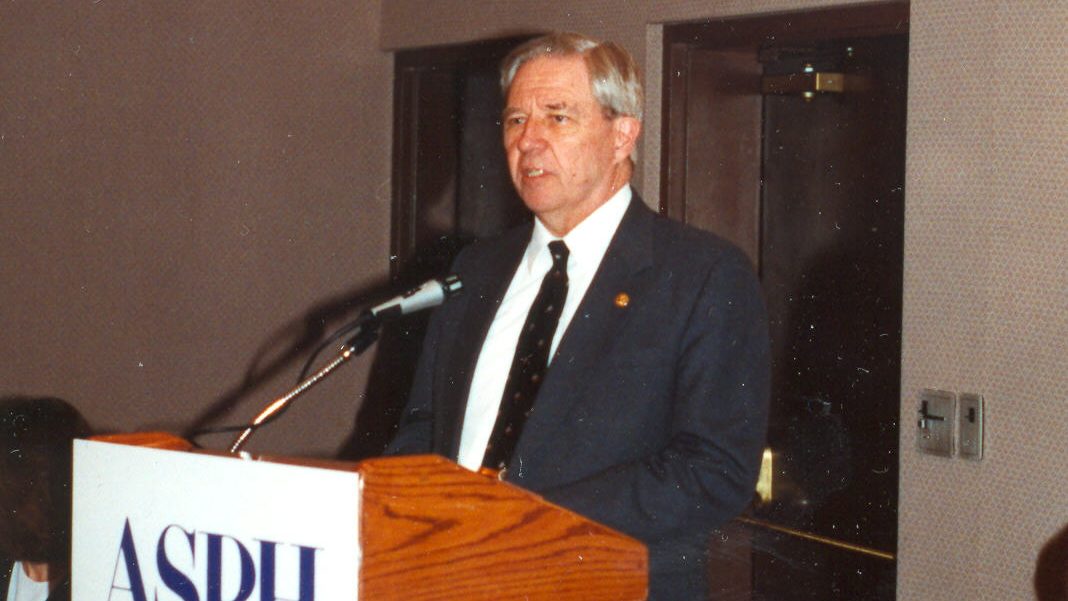
Working with leaders in the field, including Dr. Donald Ainslie “D.A.” Henderson, the epidemiologist who led the global campaign to eradicate smallpox and later served as dean of the Johns Hopkins School of Public Health, ASPH helped establish cooperative agreements between the Centers for Disease Control and Prevention (CDC) and schools of public health. These collaborations expanded opportunities for faculty engagement in applied public health and strengthened the public health workforce nationwide. ASPH was the first organization to receive a cooperative agreement with the CDC.
ASPH also advanced efforts in prevention research, accreditation standards, workforce preparedness, global health collaboration, and competency development, helping ensure that schools of public health remained central to improving the nation’s health.
Expanding Leadership and Global Scope

In 2000, the Association created a full-time presidential leadership model and appointed Harrison C. Spencer, MD, MPH, an infectious disease physician, epidemiologist, and global public health leader, as President and CEO. Spencer previously served as dean of both the Tulane University School of Public Health and Tropical Medicine and the London School of Hygiene and Tropical Medicine, bringing extensive experience in international public health and infectious disease control. Under his leadership, ASPH strengthened its national presence, expanded global engagement, and built new partnerships with academic institutions and public health organizations worldwide. By the early 2000s, the number of accredited schools of public health had more than tripled, from the original 10 to 33 by 2003.
ASPH also worked with partners across the field to advance recognition of public health as a professional discipline, helping lead efforts that resulted in the creation of the Certified in Public Health (CPH) credential. First administered in 2008, the CPH exam provides a mechanism for graduates and professionals to demonstrate mastery of core public health competencies.
As the field of academic public health evolved, ASPH broadened its membership to include accredited public health programs in addition to schools. Reflecting this expanded community, the Association became the Association of Schools and Programs of Public Health (ASPPH) in 2013.
In 2017, Laura Magaña, PhD, MS, became President and CEO of ASPPH. Under her leadership, the Association has continued to strengthen academic public health, support innovation in public health education, and expand collaboration across the global public health community. ASPPH has also expanded its international engagement, welcoming member institutions from outside the United States and strengthening partnerships across the global academic public health community. In 2023, ASPPH joined peer organizations as a founding member of the Global Network for Academic Public Health (GNAPH), an initiative that advances collaboration among academic public health institutions worldwide.

Governance
ASPPH is governed by a Board composed of leaders from member institutions. Historically, the Board was made up of deans of accredited schools of public health. As membership expanded to include accredited public health programs, governance also evolved. Today, the ASPPH Board includes deans and program directors representing CEPH-accredited schools and programs.
This leadership structure ensures that ASPPH reflects the full breadth of academic public health education while remaining guided by the leaders of member institutions.

Today and the Future
Today, ASPPH represents more than 150 CEPH-accredited schools and programs of public health across the United States and internationally. In addition to supporting its members, ASPPH leads a number of initiatives that advance academic public health through education innovation, workforce development, global engagement, and policy leadership. These initiatives address critical issues shaping the future of public health, including artificial intelligence in public health, climate change and health, gun violence prevention, healthy longevity, and efforts to transform academia for inclusive excellence.
Learn more about these initiatives and ASPPH’s ongoing work to strengthen academic public health.
As ASPPH looks ahead, we are focused on strengthening the role of academic public health in addressing the complex challenges facing communities around the world. Guided by our Strategic Plan 2030, we are advancing efforts to expand cross-sector partnerships, strengthen communication and public trust in public health, prepare the workforce for emerging challenges such as artificial intelligence and evolving career pathways, and support innovation in public health education. ASPPH is also working to foster constructive dialogue across diverse perspectives, strengthen advocacy for public health research and education, and ensure the long-term sustainability of academic public health institutions. Through these efforts, we aim to help academic public health remain a trusted, collaborative, and forward-looking force for improving population health and advancing health equity in the decades ahead.
While the field has evolved over the more than eight decades, ASPPH’s core mission remains the same:
Advance academic public health
Strengthen the public health workforce
Improve population health and achieve health equity
Key Milestones in ASPPH History
1941 — ASPH Founded
The Association of Schools of Public Health (ASPH) is founded by deans of accredited schools of public health to promote excellence in graduate public health education and strengthen collaboration across institutions.
1974 — Establishment of CEPH
ASPH and the American Public Health Association (APHA) establish the Council on Education for Public Health (CEPH), the accrediting body for schools and programs of public health.
1978 — Leadership Expansion
Michael K. Gemmell, CAE, becomes Executive Director of ASPH and leads the organization for 25 years, expanding its national presence and strengthening partnerships with federal agencies and public health organizations.
1988 — Responding to National Public Health Challenges
Following the Institute of Medicine’s landmark report The Future of Public Health, ASPH increases efforts to strengthen connections between academic public health and public health practice.
2000 — First Full-Time President & CEO
ASPH establishes a full-time presidential leadership model and appoints Harrison C. Spencer, MD, MPH, as President and CEO.
2006 — Global Expansion
ASPPH expands internationally, welcoming member institutions from outside the United States and strengthening collaboration across the global academic public health community.
2013 — ASPH Becomes ASPPH
Reflecting the growth of accredited public health programs alongside schools, the Association becomes the Association of Schools and Programs of Public Health (ASPPH) and expands membership to include CEPH-accredited public health programs.
2017 — New Leadership
Laura Magaña, PhD, MS, becomes President and CEO, continuing ASPPH’s work to advance academic public health education, workforce development, and global collaboration.
2023 — Becomes a Founding Member of GNAPH
ASPPH becomes a founding member of the Global Network for Academic Public Health (GNAPH), an alliance of seven regional associations that represent schools and programs of public health worldwide.
2023 —The ASPPH Center for Public Health Workforce Development Launches
The ASPPH Center for Public Health Workforce Development launches and is dedicated to strengthening the public health workforce, serving as a bridge between academia, practice, and communities, aiming to meet the demands of the moment and the needs of the future.
2025 /2026 — IDEA Institutes Launches
The ASPPH IDEA Institute (Innovation, Discovery, and Excellence in Academia), a dynamic, evolving initiative created to support academic public health institutions in transforming how they teach, learn, and lead, launches in 2025.
In 2026, ASPPH now proudly represents more than 150 CEPH-accredited schools and programs of public health across the United States and internationally.