
MEET ARIE
ASPPH’s AI Resource for Institutional Excellence
ARIE is the IDEA Institute’s cutting-edge, equity-focused chatbot, developed to support learning, discovery, and academic transformation across the public health spectrum.
Try ARIE
Chat with ARIE below and experience the future of public health learning.


Hello, I'm ARIE!
I’m new and learning, so I might lack the data to answer your prompt.
You won’t see sources listed with every answer. If a response doesn’t show a source, that’s ok! It’s still drawing from ASPPH’s website, approved partner website, and our curated and vetted knowledge base.
Understanding ARIE in Action

Teaching Assistant
Helping students grasp public health foundations and sharpen critical thinking

Librarian
Curating and serving up relevant Scholarship of Teaching and Learning (SoTL) resources that are aligned with the Council on Education for Public Health (CEPH) competencies and other practice-based resources

Prompt Tutor
Teaching users how to engage with AI meaningfully and ethically

Research Partner
Helping educators discover insights while contributing to longitudinal research on AI and education
Whether you’re exploring pedagogy, designing curriculum, or preparing for CEPH accreditation, ARIE offers timely, reliable support and is continually evolving, with new resources added regularly.
Why ARIE Matters: Responsible & Ethical AI
ARIE is more than a chatbot. It represents ASPPH’s commitment to the ethical and responsible use of technology in academic public health. The chatbot is designed with care to:
- Respect privacy and protect user data
- Deliver evidence-based content through an equity lens
- Empower students to explore, critique, and expand their knowledge
- Support faculty innovation without replacing human teaching
Unlike traditional AI chatbots that rely solely on generic large language models (LLMs), ARIE utilizes Retrieval-Augmented Generation (RAG) to dynamically incorporate vetted, up-to-date, and domain-specific content.
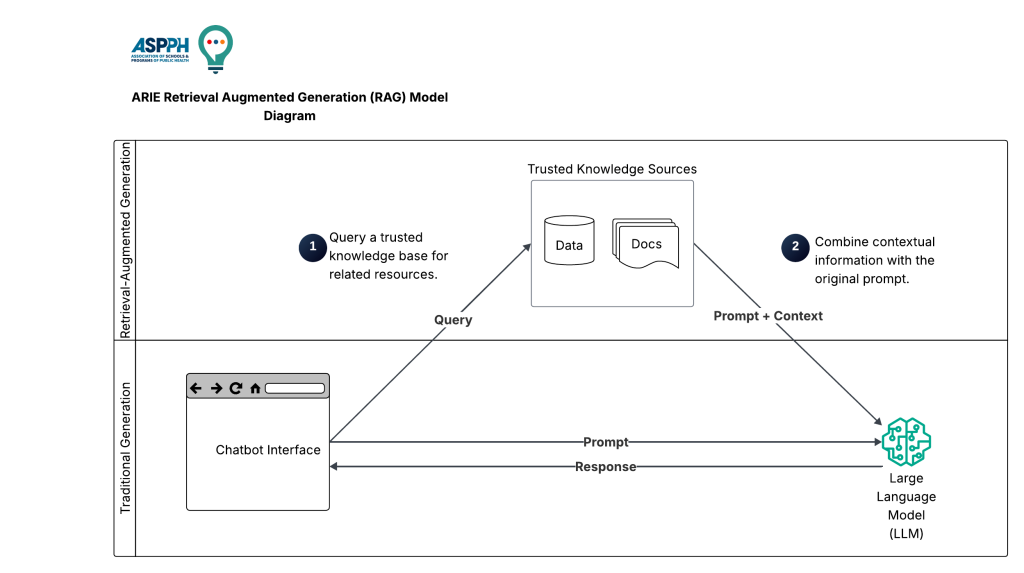
RAG combines two key steps to improve the accuracy and relevance of responses. First, it retrieves information from a trusted database or knowledge source, like ASPPH’s Academic Resource Hub, a digital library of curated documents. Then, it uses that information to generate a thoughtful and context-aware answer that includes citations to the referenced document.
Selecting the right large language model (LLM) for RAG is also critical because the LLM determines how effectively retrieved information is understood, synthesized, and communicated. For ARIE, ASPPH selected Anthropic’s Claude 3.5 Sonnet V2. Anthropic is a pioneer in the development of Constitutional AI, a method used to train AI systems with guiding principles based on the UN Universal Declaration of Human Rights.
While the RAG framework and underlying LLM provide a solid foundation for improving AI’s accuracy, contextual relevance, and reduction of false information (often referred to as hallucinations), ARIE encompasses other key components that further enhance its ethical and responsible usage.

AI System Prompts
Define the AI chatbot’s purpose, role, and tone. They provide background information and establish the context to help the AI understand the specific task at hand and tailor its responses accordingly. Think of them as ARIE’s “house rules” that guide and influence its behavior and output. The ASPPH project team carefully crafted ARIE’s system prompts specifically for academic public health and continually evaluates and updates them.

Amazon Bedrock Guardrails
An AWS service that simplifies the safety, privacy, and compliance of AI chatbots. The service provides powerful features for ARIE to filter out harmful or inappropriate content, detect and redact Personally Identifiable Information (PII), and ensure generated responses are supported by underlying source documentation.

Amazon Bedrock Evaluations
An AWS service that brings rigor and clarity to the LLM and RAG evaluation process through customized rubrics and human review workflows. The service ensures that ARIE meets the high standards of an academic environment and delivers the desired performance while aligning responses with ASPPH’s mission and values.
Built for Scalability: Deploy Your Own ARIE
Run your own version of ARIE using your curated knowledge base resources. To facilitate adoption, accessibility, and scalability, ASPPH will offer two implementation pathways:
- Templatized Playbook – for AI-capable institutions to deploy in their own AWS environments
- Fully Managed Service – operated by ASPPH for members with limited internal capacity
This dual model ensures that ARIE is available to a wide range of institutions, regardless of size or infrastructure.
Curious to Learn More?
We’d love to explore how we can support your work. Connect with IT to share feedback, ask questions, or discuss your program’s needs.
Your Guided Path to ARIE Success
As part of our templatized playbook and fully managed service offerings, ASPPH equips you with comprehensive, ready-to-use documentation designed to streamline your implementation journey.
Explore the curated materials that have supported the successful development of ARIE, and which can help accelerate your own efforts:


Technical Writeup
Dive into the system’s design and integration principles, guardrails (responsible and ethical use of AI)




Additional Resources Forthcoming
We will provide more tools to support your planning and delivery as they are produced.
Coming Soon
Driving Research, Informing Practice
Interaction data from ARIE (fully anonymized) will feed into ASPPH’s data lake, supporting research on generative AI’s effectiveness as a teaching and learning tool.
This information helps us refine best practices, improve pedagogy, and strengthen the impact of public health education across the field.
Looking Ahead
AI will transform every aspect of human society, both positively and negatively. Some effects can be forecasted, but others may be unanticipated and potentially harmful if not managed carefully. These are three examples to consider:

AI & Robotic Convergence
as the integration of AI with robotic systems grows, enabling machines to perceive, interpret, and act autonomously in the physical world, the safety, ethical, and moral hazards of human-machine interactions are at stake.

Power & Climate Implications
as adoption accelerates globally, the power consumption and climate implications are becoming increasingly significant. Based on some estimates, the yearly carbon footprint of ChatGPT is approximately 8.4 tons of CO2. That’s just from a single LLM and based on current performance levels. Without a clean energy strategy, AI will accelerate the release of harmful emissions from fossil fuel-heavy grids.

Community-level Impacts
AI data centers are often located in low-income or rural areas, and electricity demands are not the only strains on these communities. Water usage, critical to cooling heat-generating processors, land usage, and industrial noise and pollution, among other concerns, can exacerbate social determinants of health.
Thank you to our partner, AWS
ASPPH is grateful for the support from our partner, Amazon Web Services (AWS), who helped develop ARIE and whose AI technologies enable us to bring this learning innovation to life. Discover more about AWS’s AI and Machine Learning Services.