
Governmental Public Health Workforce Preparation Curriculum Toolkit
About the Toolkit
Developed by the Association of Schools and Programs of Public Health (ASPPH) with funding from the Public Health Accreditation Board (PHAB), the Governmental Public Health Workforce Preparation Curriculum Toolkit translates findings from the 2024 Governmental Public Health Job Task Analysis into ready-to-use instructional resources for schools and programs of public health. The toolkit includes facilitator guides, presentation slides, and activity guides designed to help faculty integrate governmental public health concepts and practices into their courses. By connecting academic instruction with the essential tasks performed by the governmental public health workforce, the curriculum supports the preparation of students to work in or with governmental public health agencies.
This is Governmental Public Health
Governmental public health is the work carried out by federal, state, Tribal, local, and territorial (STLT) governments to protect and improve the public’s health. These governments have different structures, roles, and responsibilities. Governmental public health is part of a broader public health system that also includes healthcare organizations, academic institutions, businesses, and other partners.

Domain 1: Administration and Support
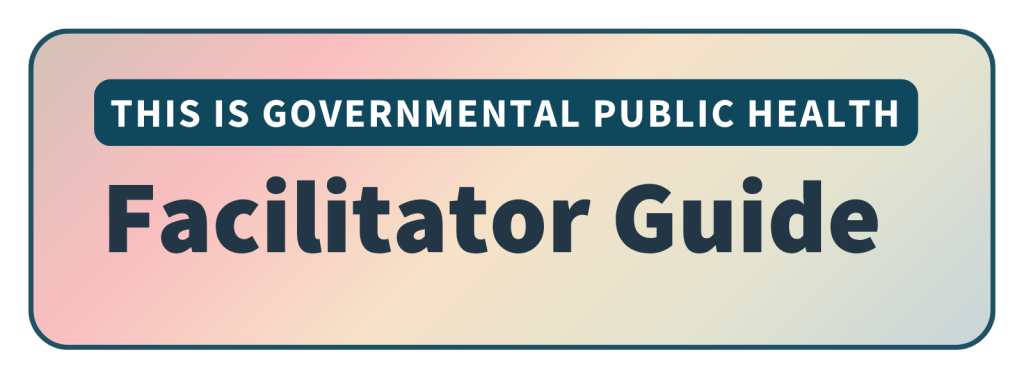
Domain 1: Administration and Support describes the governmental public health infrastructure, workforce systems, and operational functions that enable state, Tribal, local, and territorial (STLT) health departments to carry out their public health responsibilities. This domain focuses on workforce development, performance systems, financial stewardship, organizational planning, accreditation, and technology infrastructure that support day-to-day operations, emergency preparedness, and long-term jurisdictional performance.

Domain 2: Communication
Domain 2: Communication describes the governmental public health systems, communication functions, and operational practices that enable state, Tribal, local, and territorial (STLT) health departments to share timely, accurate, and accessible information to support public health action, emergency response, and community trust.

Domain 3: Community Engagement and Education
Domain 3: Community Engagement and Education describes how state, Tribal, local, and territorial (STLT) health departments partner with communities, incorporate community perspectives into decision-making, and share public health information to improve population health outcomes.

Domain 4: Direct and Field Services
Domain 4: Direct and Field Services describes the hands-on governmental public health services provided directly to individuals, families, and communities by state, Tribal, local, and territorial (STLT) health departments to prevent disease, protect health, and/or connect people to care. This domain focuses on the processes, infrastructure, and coordination needed within STLT health departments to be able to effectively deliver services across a variety of clinical, community, and field-based environments and work to identify and respond to community health needs and priorities.

Domain 6: Information and Data
Domain 6: Information and Data describes how state, Tribal, local, and territorial (STLT) health departments collect, manage, analyze, interpret, visualize, evaluate, and communicate data to inform governmental public health decision-making, planning, and action. This domain focuses on data stewardship, data collection and analysis, surveillance, program evaluation, data visualization, assessment, and communication practices that support both day-to-day operations and evidence-informed public health practice.

Domain 7: Policy and Governance
Domain 7: Policy and Governance describes how state, Tribal, local, and territorial (STLT) health departments operate within legal authority and governance structures to support effective governmental public health practice. This domain focuses on the laws, regulations, decision-making processes, and governance relationships that shape how governmental public health functions.
Domain 8: Program Planning and Management
Domain 8: Program Planning and Management describes how state, Tribal, local, and territorial (STLT) health departments translate public health priorities into coordinated, sustainable action. This domain focuses on the systems, planning processes, partnerships, funding strategies, and emergency readiness efforts that allow governmental public health to function effectively.
In partnership with the Public Health Accreditation Board (PHAB), this work is supported by funds made available from the Centers for Disease Control and Prevention (CDC) of the U.S. Department of Health and Human Services (HHS), National Center for STLT Public Health Infrastructure and Workforce, through OE22-2203: Strengthening U.S. Public Health Infrastructure, Workforce, and Data Systems grant. The contents are those of the author(s) and do not necessarily represent the official views of, nor an endorsement, by CDC/HHS, the U.S. Government, or PHAB.