
AI for Public Health
Advancing academic public health through the responsible, ethical, and effective use of artificial intelligence.
The ASPPH AI Task Force Report is now available. Explore the framework and recommendations shaping the future of AI in public health education, research, practice, and policy.

ASPPH’s Leadership: Artificial Intelligence for Public Health
Recognizing the growing impact of artificial intelligence (AI) on public health education, research, practice, and policy, ASPPH convened the Task Force for the Responsible and Ethical Use of Artificial Intelligence in Public Health Research, Practice, and Education. Comprised of experts from across academic public health and related sectors, the task force was charged with developing a framework and recommendations to guide the responsible, ethical, and effective use of AI.
The resulting report, Harnessing Innovation: Artificial Intelligence for Public Health, provides a roadmap for academic public health institutions to navigate the opportunities and challenges of AI. Grounded in four pillars—Teaching and Learning, Education and Workforce Development, Practice and Research, and Policy, Governance, and Infrastructure—the framework emphasizes safety, accountability, equity, and innovation.
Building on the report’s recommendations, ASPPH is now advancing implementation efforts through the IDEA Institute, including webinars, collaborative learning exchanges, and educational resources designed to help institutions translate the framework into practice. Stay tuned for when these implementation efforts are launch later this summer 2026.
Why Responsible and Ethical Use of Artificial Intelligence Matters
Embracing the Future
This work is critical as technology rapidly transforms how we teach, learn, and practice public health. Without a coordinated and ethical approach, we risk falling behind in preparing students and professionals for a digitally interconnected world and workforce. The taskforce ensures that academic public health remains agile, impactful, and forward-looking in the face of accelerating technological change.
AI presents powerful opportunities:
- Improving public health surveillance and crisis response
- Advancing personalized, data-driven education
- Enabling efficient, equitable allocation of healthcare resources
However, it also introduces significant challenges:
- Data privacy and security risks
- Potential for algorithmic bias and inequity
- Gaps in technical and ethical training

This initiative is a proactive effort to establish shared principles and protocols to ensure AI strengthens, not undermines, public health values.
Task Force Goals

Review existing AI policies and guidelines across ASPPH member institutions and national/global bodies

Develop a framework of best practices for the ethical, responsible, and safe use of AI in public health education, research, and practice

Propose recommendations for institutional policy, regulatory alignment, and future-ready AI workforce development

Foster collaboration between academia, government, technology partners, and global public health organizations
Get Involved

Stay connected to this work. Sign up to receive updates, future public engagement opportunities, and be notified when the task force report is released.
Key Areas of Focus
Key areas of focus for the task force are based on ASPPH’s Technology Framework. The framework was developed by the Technology Advisory Committee when evaluating technology for the academic enterprise, whether the latest in AI, machine learning, robotics, or trusted data analytics systems, institutional leaders must consider these four pillars of a comprehensive public health technology landscape.

Teaching & Learning
How technologies can be used in the classroom to enhance student engagement and interaction

Education
Preparing students with the skills they need in a tech-enabled field

Practice & Research
Responsibly applying technology in the field

Policy, Regulatory & Architectural Frameworks
Delivering scalable, resilient, and secured technology services
Resources and Opportunities
Virtual AI Roundtable Series: Teaching and Learning in Academic Public Health
AI is reshaping teaching and learning in academic public health. Join the virtual conversation.
Connect with faculty and peers for practical, interactive discussions about how AI is being applied in public health education.
Explore topics:
- Building Critical AI Literacy in Teaching Public Health Education
- Creating AI-Powered Learning Experiences
- Designing AI-enabled Tools for Teaching
- Redesigning Assignments and Assessments with AI
Learn from peers, share promising practices, and explore approaches you can adapt at your own institution. Register for one or all four roundtables. The series supports implementation of the ASPPH AI Taskforce Framework and will continue to grow with additional topics and roundtables.
Earn CPH Continuing Education Credit: Participants can earn 1 CPH CE credit for each eligible AI Roundtable session attended.

Research Article: Emerging Trends in Generative AI Policy Across Schools and Programs of Public Health
How are schools and programs of public health navigating the rise of generative AI? This new study uncovers emerging policies, critical gaps, and what’s needed to responsibly scale AI use across education and research.

Artificial Intelligence and Public Health: A Moment That Demands Leadership
In her January 16, 2026 op-ed, ASPPH President & CEO Dr. Laura Magaña explores how AI is transforming public health, shaping data analysis, risk prediction, and resource allocation across today’s healthcare landscape.

Recommended Books for Faculty and Staff
Explore a list of recommended books by ASPPH on faculty development and instructional design, strategic and contextual perspectives on Artificial Intelligence.

Advancements in Responsible & Ethical Use of AI in Public Health Education: Updates From ASPPH’s AI Task Force
Our December 9, 2025 ASPPH Presents webinar, Advancements in Responsible & Ethical Use of AI in Public Health Education: Updates from ASPPH’s AI Task Force, showcased the latest work of ASPPH’s Task Force for the Responsible and Ethical Use of Artificial Intelligence in Public Health Research, Practice, and Education. The Task Force is advancing efforts to ensure AI is integrated ethically, equitably, and innovatively across public health education.
Task Force leaders shared updates on current initiatives, insights from cross-sector collaboration, and a preview of the draft Executive Summary outlining guiding principles and recommendations for the field.
This webinar is essential for public health educators, faculty, administrators, and practitioners seeking to stay informed about ASPPH’s leadership in shaping the future of AI in public health.
Incorporating AI into the Scholarship of Teaching and Learning
In May 2025, we hosted a session in the ASPPH Presents webinar series, Incorporating GenAI into the Scholarship of Teaching and Learning, which explored how Generative AI can enhance student engagement, critical thinking, and evidence-based learning in public health education.
The session highlighted practical ways to use GenAI to support student-centered learning and prepare students for a tech-enabled workforce.
Process and Timeline
| Phase | Timeline | Activities | Status |
| Task force Formation | Spring 2025 | Recruitment of multidisciplinary experts and collaborators | Completed |
| Discovery & Consultation | Summer 2025 | Collaborator interviews, policy reviews, and survey of ASPPH member institutions | Completed |
| Draft Framework Development | Fall 2025 | Development of a preliminary framework based on gathered insights | Completed |
| Public Webinar on Taskforce Updates | December 2025 | Hosted webinar to provide updates on AI Taskforce’s progress and open dialog to the public for comment on process to date. | Completed |
| Draft Framework Released | January 2026 | Publication of the draft framework public review and comment. | Completed |
| Community Feedback Period | January – April 8, 2026 | Circulation of draft for feedback from the academic and public health community | Completed |
| Townhall: Responsible and Ethical Use of AI in Public Health | March 19, 2026 | Released draft report and welcomed feedback and dialogue with our ASPPH Annual Meeting attendees. | Completed |
| Final Report Publication | Summer 2026 | Release of the final framework and guidance toolkit for implementation | Completed – access here! |
Technology Advisory Committee
The ASPPH Technology Advisory Committee focuses on the role of technology innovation in advancing education in public health, our members’ research mission, and public health practice. The committee also seeks to promote the adoption of and provides guidance on the equitable, ethical, and responsible use of technology within the academic public health enterprise.
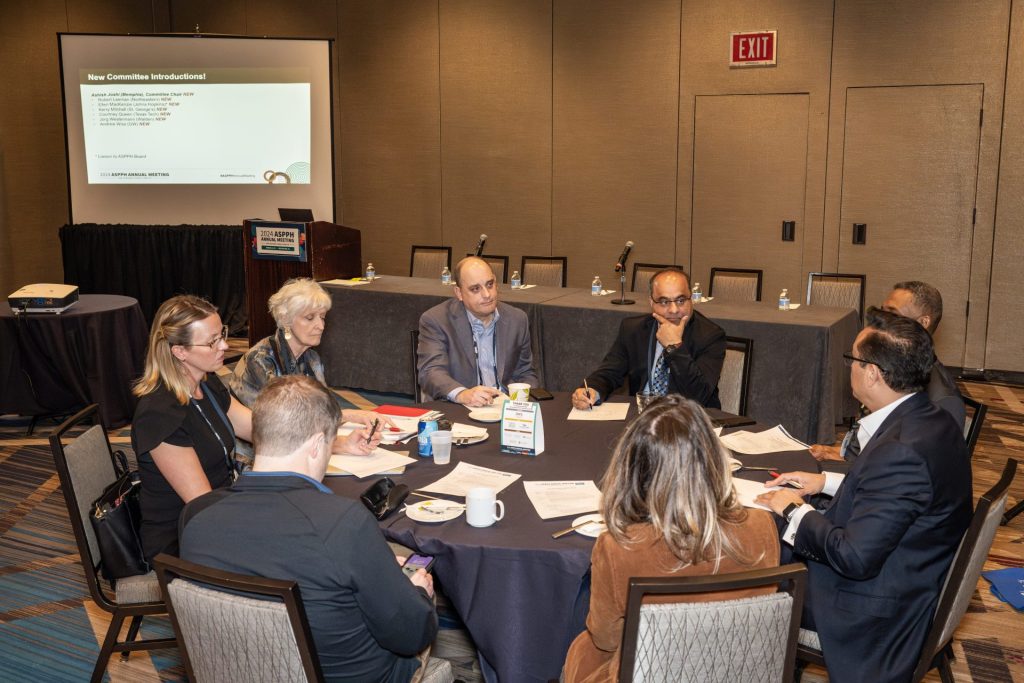
AI Task Force Members

Ashish Joshi
PhD, MBBS, MPH
Chair
Dean, and Distinguished University Professor, University of Memphis School of Public Health


Associate Professor of Public Health, Andrews University School of Population Health, Nutrition & Wellness

Director, Teaching Innovation and Excellence, School of Public Health and Health Professions, University at Buffalo

Chair, Department of Public Health and Health Sciences; Professor
Public Health and Health Sciences, Northeastern University, Bouvé College of Health Sciences

Chair & Associate Professor, Department of Public Health and Preventive Medicine, St. George’s University

Assistant Director of CRM, Administrative and Web Services
Harvard T.H. Chan School of Public Health

Director, Master of Public Health Program
Northwestern University Feinberg School of Medicine Program in Public Health

Professor of Professional Practice in Public Health Sciences
Director of the Online MPH Program, University of Miami Department of Health Sciences

Assistant Professor, Director of the Data Science Program, College of Global Population Health at UHSP in St. Louis

Associate Dean for Strategic Partnerships and Interim Department Chair for the Texas Tech University Health Sciences Center, Julia Jones Matthews School of Population and Public Health




Associate Professor
Department of Epidemiology & Biostatistics, University at Albany College of Integrated Health Sciences

Dean, Louisiana State University Health Sciences Center School of Public Health

Dean, School of Health Sciences, Walden University College of Health Sciences and Public Policy

Assistant Dean for Academic Innovation & Professorial Lecturer, George Washington University Milken Institute School of Public Health

Digital Learning Support Specialist, Columbia University Mailman School of Public Health
ASPPH Staff

Chief Information Officer

Senior Director of Innovation and Strategy