



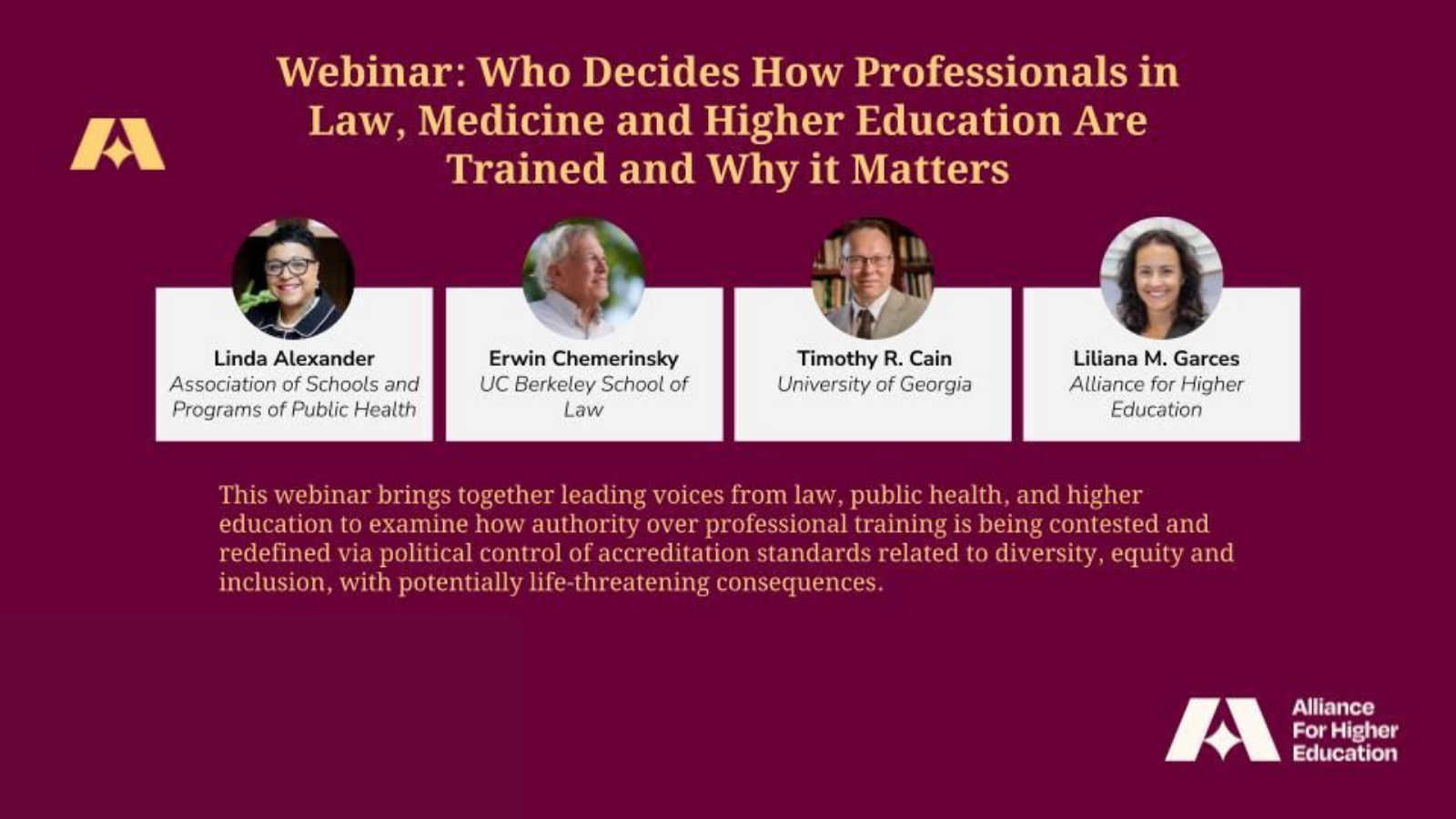
ASPPH Chief Academic Officer Dr. Linda Alexander recently joined experts in higher education policy and law for the Alliance for Higher Education webinar, “Who Decides How Professionals in Law, Public Health and Higher Education Are Trained and Why it Matters.” The discussion examined the role of accreditation in maintaining professional standards and how increasing political intervention could affect education, professional preparation, and public trust.
During the discussion, Dr. Alexander emphasized that accreditation serves as an important system of professional self-governance, allowing experts to establish standards for educational quality, ethical practice, and workforce preparation. She described accreditation as the “industry standard for higher education” and underscored the importance of maintaining standards grounded in evidence and professional expertise.
From a public health perspective, Dr. Alexander highlighted the importance of preparing future professionals to understand the many factors that shape health outcomes, including access to care, environmental exposures, geography, public policy, and bias within health systems. She cautioned that removing education around equity and bias could leave graduates less prepared to understand and address persistent health disparities.
“We live, work, and play in a multiracial society. Therefore, it is imperative that the 21st century public health workforce be prepared to address a myriad of factors that might impede optimal health. To that end, the training and preparation of our workforce through accreditation standards ensures alignment with the needs of society and the education of those trained to provide guidance, leadership, and actions toward desired health outcomes. There is no room for politicization in the equation of who is best positioned to determine how public health students are trained nor for political pandering in terms of educational competencies in academic public health curricula.” – Dr. Linda Alexander, ASPPH Chief Academic Officer
Panelists also explored accreditation developments in legal and higher education and emphasized the value of maintaining professional expertise in decisions about how future professionals are trained.