My first serious consideration of public health as a career began during one of the most defining moments of our generation — the COVID-19 pandemic. The memory is vivid: headlines dominated by rising case numbers, images of overwhelmed hospitals circulating across the world, and an unsettling sense that we were collectively holding our breath. The world seemed to be on the verge of shutting down, and the cracks in our preparedness were painfully visible. I remember thinking, how could something so impactful catch the entire globe off guard? This was not just an academic curiosity — it was a question that kept me awake at night. Why was there such a global deficit in infectious outbreak response? Why, despite decades of medical advancement, did our systems fail to respond with the efficiency and foresight we desperately needed?
As I searched for answers, I realized I was not just reading about viruses and vaccines — I was uncovering a field that, until then, I hadn’t considered as a career: public health. Being an international student in India at the time, my exposure to the breadth of the field was limited. My academic interests had always leaned toward science and health, but public health seemed to be this broad, interconnected discipline that went beyond treating individuals to safeguarding entire populations. The more I learned, the more I realized that public health was the bridge between knowledge and action — a space where research meets real-world implementation, and where even small interventions could ripple outward to protect thousands, if not millions, of lives.
This realization sparked a turning point for me. I began reading extensively about epidemiology, disease surveillance systems, and outbreak response strategies. I followed the news more critically, analyzing the varied responses of different countries. Some nations seemed to have contained the spread swiftly, while others struggled with resource shortages, misinformation, and public mistrust. I began to appreciate the complexity of these challenges — that fighting an infectious disease was not simply about having the right medicine, but also about coordination, policy, communication, and community engagement. It became clear to me that through public health, I could contribute to the well-being and safety of thousands of people at once, rather than helping individuals one at a time. That thought was powerful — and it led me directly to where I am today.
My name is Arya Mhatre, and I am currently a second-year Master of Public Health (MPH) student at the University of South Florida in Tampa. My concentration is Global Communicable Diseases, and my academic interests lie particularly in nosocomial infections and surgical site infections — both of which present unique and urgent challenges in healthcare systems around the world. While my decision to join the MPH program was driven by a desire to better understand infectious diseases, I could not have predicted the diversity of opportunities and experiences that awaited me once I stepped into the program.
Looking back, I consider myself extremely fortunate to have been exposed to a wide variety of experiences that have shaped my growth both as a student and as a future public health professional. Each opportunity has taught me something distinct, and each has reinforced my belief that public health is not just a career — it’s a collaborative, ever-evolving commitment to improving lives.
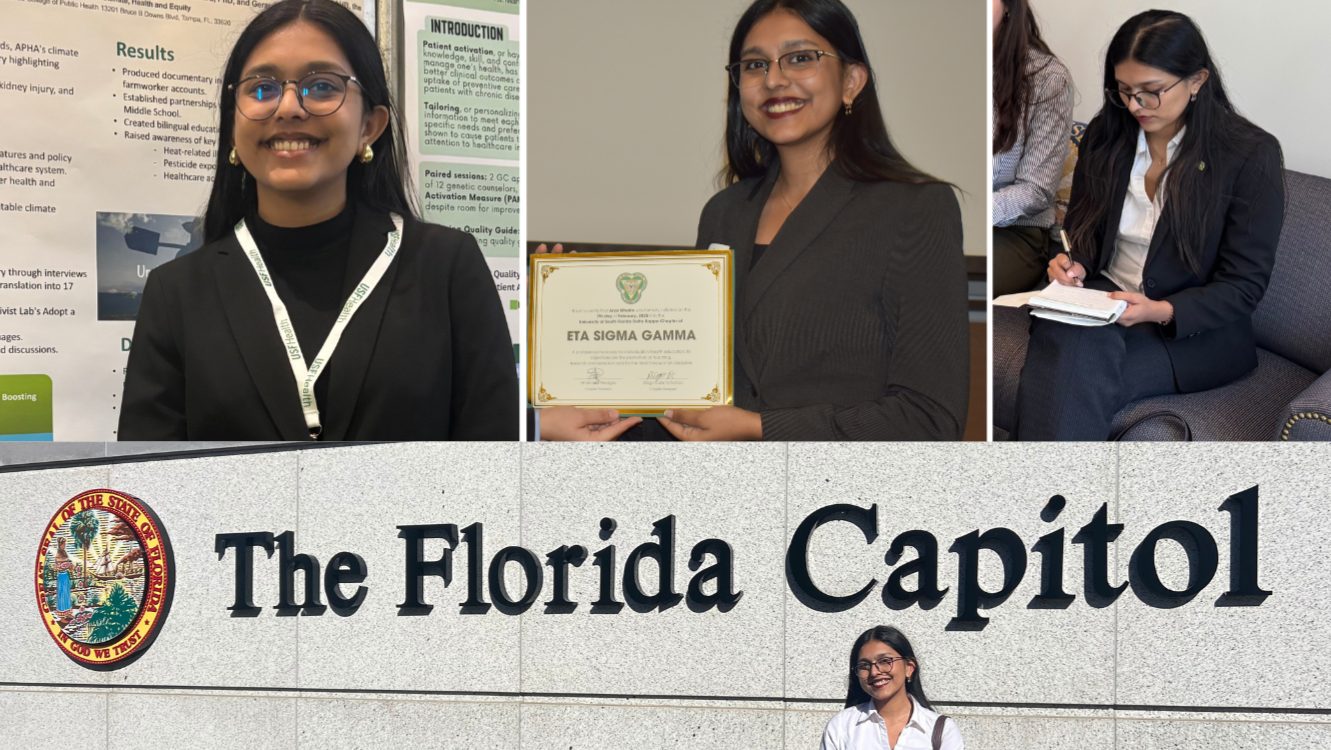
One of the first transformative experiences I had was presenting my first research poster at a health research conference. It was both nerve-wracking and exhilarating. Standing by a project, answering questions, and engaging with researchers from across disciplines showed me how knowledge-sharing fuels innovation. It wasn’t just about presenting an idea — it was about listening, absorbing, and making connections with people who were tackling public health challenges from entirely different perspectives. That moment gave me a deep appreciation for the importance of conferences and scholarly exchange in driving the field forward.
Another memorable experience was traveling to the Florida Capitol with fellow peers to advocate for and against certain proposed bills. It was my first real introduction to health policy advocacy — an area of public health I had only read about until then. I saw firsthand how public health professionals can influence legislation, and how important it is for experts to have a seat at the table when decisions that affect entire communities are being made. It was empowering to realize that my voice, even as a student, could contribute to these conversations.
Being selected into a public health honor society was another milestone. It validated not just my academic performance, but also my commitment to service and leadership within the field. This recognition reminded me that public health is built on collaboration, integrity, and dedication — qualities I strive to cultivate in my professional journey.
Perhaps one of the most valuable lessons I have learned through all these experiences is the importance of asking. In my early days as a student, I, like many others, hesitated to reach out, to volunteer, or to express interest in opportunities. There is often an unspoken fear — fear of being perceived as too eager, of imposing on someone’s time, or of facing rejection. Faculty and experts can seem intimidating, and the idea of approaching them with questions or requests can feel daunting. But over time, I discovered that curiosity and initiative are exactly what many opportunities look for.
The truth is, universities and organizations often have incredible programs, research projects, and community outreach initiatives that need student involvement — they just aren’t always well advertised. A simple email, a question after class, or a conversation during office hours can open doors you didn’t know existed. I’ve learned that “asking” is not a sign of inexperience, but rather a demonstration of engagement and willingness to contribute.
This mindset of asking and seeking opportunities has brought me to some of my most rewarding experiences. It was by asking that I became a This Is Public Health (TIPH) ambassador, representing the field to the broader community and advocating for its importance. It was by asking that I became involved in an ongoing research project in Panama, allowing me to apply my classroom knowledge to an international context and gain insights into cross-border health challenges. And it was by asking that I took on a role as a Restoring Family Links Coordinator with the American Red Cross, where I help reconnect families separated by crises — an experience that has been deeply humbling and humanizing.
I often think about how different my journey might have been if I had learned this lesson earlier, during my undergraduate years. Back then, I assumed opportunities were rare and only came to those who were “chosen.” Now I know that while some opportunities do come unexpectedly, many others are simply waiting for someone to show interest. All it takes is the courage to reach out.
Public health is not just about scientific knowledge or policy expertise — it’s about building relationships, fostering trust, and taking initiative. My experiences have shown me that every connection, every conversation, and every act of curiosity can lead to something meaningful. This belief continues to shape how I approach my studies, my professional roles, and my interactions with the broader community.
As I look ahead, I see my career in public health as a continuation of this journey — a path defined by curiosity, advocacy, and service. My focus on global communicable diseases will guide me toward work that addresses the urgent challenges of infection prevention, particularly in healthcare settings. I envision contributing to research that informs better infection control practices, working with international teams to strengthen health systems, and advocating for policies that protect vulnerable populations.
But no matter where my career takes me, I will carry forward the lesson that has shaped my graduate school experience more than anything else: always ask. The worst response you can receive is “no,” but more often than not, you’ll find that people are eager to support someone who is genuinely interested and committed. Every “yes” I’ve received so far has not only expanded my skills and knowledge but also reinforced my belief in the collective power of the public health community.
Public health is, at its core, about people — about listening to them, learning from them, and working alongside them to create a healthier, more equitable world. My journey from questioning pandemic response to actively contributing in research, advocacy, and service has been shaped by a willingness to step forward, speak up, and engage. And I know that as long as I keep asking, there will always be another opportunity to learn, to serve, and to make a difference.